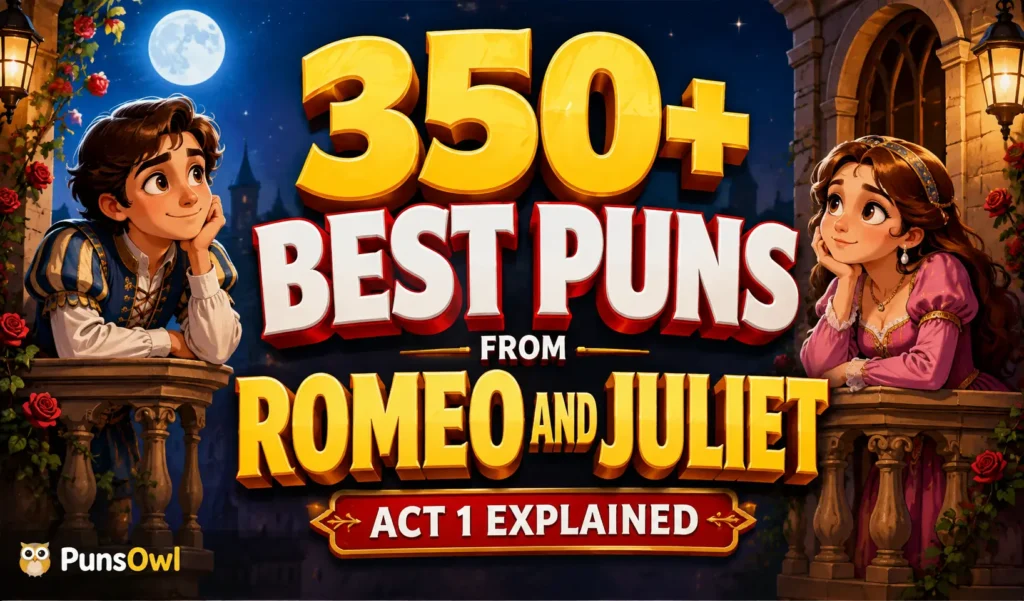
When you read the opening of Shakespeare’s most famous tragedy, you might be surprised by the sheer volume of Romeo and Juliet puns. Before the tears and poison, the streets of Verona are alive with Shakespearean humor. This clever wordplay wasn’t just for laughs; it was a masterful literary device used to establish characters and tension. Whether you are creating lesson plans or just love classic literature, exploring the Act 1 puns offers a fascinating glimpse into a world where comedy and tragedy walk hand in hand.
Table of Contents
Puns in Romeo and Juliet Act I
Act 1 is packed with Shakespeare wordplay that sets the tone for the entire play, transitioning from bawdy street banter to romantic melancholy.
In the opening scenes, the Montague and Capulet feud isn’t just fought with swords, but with sharp tongues. The comedic relief in these early moments provides a necessary contrast to the impending doom. By starting with funny and aggressive jokes, Shakespeare hooks his audience immediately. If you want to analyze how tragedy builds from comedy, you must first master the intricate word jokes scattered throughout these initial encounters.
Examples Of Puns From Romeo And Juliet (Act 1)
While students often search for three main examples for a character analysis, here are seven foundational instances of play quotes featuring double meanings.
coals and colliers: The servants joke about not carrying coals, meaning they won’t endure insults, playing on the word for coal miners.
Choler and collar: Continuing the coal joke, they pun on “choler” (anger) and drawing one’s head out of a “collar” (a hangman’s noose).
Move and stand: Sampson jokes that being moved makes him strike, while Benvolio counters that a valiant man stands his ground.
Civil and cruel: A play on the word “civil” regarding the maids, mixing courteous behavior with violent intent.
nimble soles and soul of lead: Romeo claims he cannot dance because he has a heavy soul, contrasting it with the nimble soles of his friends’ shoes.
Measure and dance: Benvolio suggests they “measure them a measure,” playing on sizing someone up versus a formal dance routine.
Prick and love: Mercutio uses bawdy humor, suggesting that if love is rough with you, be rough with love, playing on literal and figurative thorns.
Puns In Romeo And Juliet Act 1 Scene 4
This specific scene is a goldmine for literary analysis as Mercutio and Romeo engage in a rapid-fire battle of wits.
heavy lightness: Romeo uses this oxymoronic pun to describe how his love for Rosaline feels physically burdensome yet lacking in real substance.
serious vanity: Another contradiction from Romeo, playing on the idea of trivial things holding massive weight in his mind.
Lie and dream: Mercutio claims that “dreamers often lie,” punning on lying down to sleep and telling falsehoods.
Visage and visor: Mercutio jokes about putting a mask (visor) on his already ugly face (visage), hiding his true self for the party.
Done and dun: Mercutio plays on “dun” (a dull grayish-brown color or a horse) and being “done” with the night’s festivities.
Burn daylight: Mercutio tells Romeo they are wasting time (“burning daylight” at night), playing on the literal torches versus wasting figurative energy.
Puns in Romeo and Juliet: Examples and Purpose
The purpose of Romeo and Juliet puns is to entertain diverse audiences while layering deep thematic meaning into the dialogue.
William Shakespeare didn’t just write jokes for the sake of being funny; his Shakespeare wordplay served vital narrative functions. The timeless nature of his writing lies in how a single line can amuse the groundlings and challenge the nobles simultaneously. This duality is a cornerstone of Shakespearean humor, proving that literary devices like double entendres are essential for rich storytelling. When you study these lines, you see how they build dramatic irony and emotional depth.
Puns to Engage the Audience
To keep rowdy crowds entertained, the playwright used comedic relief that ranged from highly intellectual to wonderfully crude.
Bawdy street banter: The opening scene uses aggressive sexual innuendo to immediately grab the attention of the commoners.
Physical slapstick in words: Jokes about fighting and biting thumbs double as physical stage directions for the actors.
Class-based humor: Servants mock the high-minded language of their masters, creating relatable humor for the working-class audience.
Pacing adjustments: Fast-paced banter acts as an energetic palate cleanser before heavy, dramatic monologues.
Musical wordplay: Punning on musical terms engages the musically literate crowd members.
Satire of romance: Mercutio’s crude jokes directly mock the overly flowery, unrealistic poetry of courtly lovers.
Interactive insults: The characters practically invite the audience to laugh at the opposing family’s foolishness.
Predictable punchlines: Setting up a rhyme scheme where the final, punny word is obvious but hilariously subverted.
Puns to Reveal Character
Wordplay acts as a window into a character’s mind, making it a brilliant tool for a character analysis or essay writing.
Romeo’s self-pity: His puns are often heavy, contradictory, and focused on his own emotional turmoil, showing his initial immaturity.
Mercutio’s cynicism: His rapid, sharp wit reveals a deeply skeptical mind that hides behind aggressive humor.
Tybalt’s literalism: Tybalt rarely puns, showing his rigid, humorless, and violently strict nature.
The Nurse’s earthiness: Her puns are accidental or delightfully bawdy, highlighting her practical, unrefined perspective on life and love.
Juliet’s intelligence: When she uses double meanings, they are sharp and carefully controlled, showing her quick intellect.
Benvolio’s mediation: His wordplay often tries to balance or defuse the tension created by others.
The servants’ bravado: Sampson and Gregory use big words improperly to puff themselves up, revealing their insecure social standing.
Why Shakespeare’s World is Full of Puns
Understanding the cultural context is crucial for any study guide or unit study on Elizabethan literature.
Linguistic evolution: The English language was rapidly expanding, making early modern English a playground for testing new meanings.
Lack of scenery: Without elaborate sets, dramatic irony and vivid wordplay had to paint the entire picture for the audience.
Rhetorical education: Elizabethan audiences were heavily trained in rhetoric and expected complex verbal gymnastics in public speaking.
The power of homophones: Standardized spelling didn’t exist, making homophones much more fluid and common in daily conversation.
Social mobility: Witty banter was a way to display education and social status, acting as verbal peacocking.
Censorship navigation: Double meanings allowed playwrights to sneak political and bawdy jokes past the Master of the Revels.
Aural culture: People went to “hear” a play, not just see it, so auditory engagement was the primary focus.
Thematic echoing: Puns allowed concepts like love and death to mirror each other repeatedly throughout the script.
Pure entertainment value: In an era before modern media, a well-crafted pun was highly prized intellectual entertainment.
Crafting the Perfect Romeo and Juliet Wordplay
The mechanics behind these jokes rely heavily on figurative language, homophones, and rapid semantic shifts.
To truly explain the brilliance of these lines, one must look at the technical construction of the word jokes. Shakespeare was a master of iambic pentameter, weaving complex double entendre into the strict rhythm of his verse. This allowed the thematic elements of love, violence, and fate to intertwine seamlessly. For those tackling exam prep, recognizing whether a joke relies on sound or meaning is the key to unlocking the text.
Puns of Meaning
These instances of Shakespeare wordplay rely on a single word possessing two distinct, often conflicting definitions.
Conceit and understanding: Playing on “conceit” as an idea versus arrogant pride during discussions of love.
Gravity and weight: Discussing the “gravity” of a situation while physically carrying a heavy burden.
measure them a measure: Using “measure” as a unit of judgment and “measure” as a formal dance step.
serious vanity: Exploring how the frivolous “vanities” of youth carry deadly “serious” consequences in Verona.
Strike and hit: Juggling the concept of striking an enemy with a sword versus striking the target of Cupid’s arrow.
Part and depart: Benvolio tries to “part” the fighting men, only for Tybalt to threaten him to “depart” this life.
Homophones as Puns
A cornerstone of classic Elizabethan comedy, these jokes exploit words that sound identical but carry vastly different definitions.
nimble soles and soul of lead: The most famous homophonic joke, contrasting footwear with spiritual heaviness.
coals and colliers: A rapid-fire sequence playing on choler (anger), collar (noose), and collier (coal carrier).
dreamers often lie: A brilliant twist on “lie” (to recline in bed) and “lie” (to tell falsehoods in a dream).
Hart and heart: Romeo speaks of a hunting a deer (hart) while actually discussing the romantic pursuit of a human heart.
I, ay, and eye: Juliet later uses this triple homophone in a moment of panic, though the groundwork for such sounds is laid early on.
Tale and tail: Bawdy jokes from the servants often confuse telling a story (tale) with a physical appendage or sexual reference (tail).
Medlar and meddler: Mercutio insults the nurse by calling her a meddler, disguised as a joke about a rotten medlar fruit.
Chaste and chased: Romeo laments that Rosaline is “chaste” (pure), while his friends joke he is merely tired from being “chased” away.
A Love Affair with Words: Puns from Verona
The style of Act 1 puns a character uses directly reflects their personality, social standing, and emotional state.
In the streets of Verona, language is a weapon, a shield, and a tool of seduction. The witty exchanges between characters are not just for show; they drive the character development forward. From the poetic melancholy of the young lovers to the crude jests of the street brawlers, every pun example is tailored to the speaker. If you want to share a deep understanding of the play, look at who is delivering the joke.
Puns by Romeo
Romeo utilizes highly romantic and often depressive wordplay to express his early infatuation with Rosaline.
Being tied to a “heavy lightness” when describing his unwanted feelings of love.
Claiming he is “too sore enpierced with his shaft” to soar with Cupid’s light feathers.
Stating he has a “soul of lead” that stakes him to the ground during a lively party.
Comparing love to a “choking gall,” playing on the bitter taste of rejection versus the sweetness of affection.
Calling his unrequited love a “cold fire,” emphasizing the burning pain of a frozen heart.
Joking that he is a “candle-holder” who will look on, playing on both holding a light and being a passive observer.
Describing a kiss as a sin that is “purged” by another kiss, turning religious vocabulary into a flirtatious game.
Puns by Mercutio
Mercutio delivers the most aggressively clever and cynical lines, tearing down the romantic ideals of his friends.
His famous jab that “dreamers often lie,” instantly undercutting Romeo’s prophetic anxieties.
Advising Romeo to “Prick love for pricking,” turning a romantic woe into a violent, bawdy sexual joke.
Punning on “dun” as a mouse color, a tired horse, and being finished with a dull conversation.
Mocking Tybalt as a “Prince of Cats,” a deeply layered insult regarding fencing styles and a fable character.
Joking about “burning daylight,” playfully insulting Romeo’s logic about wasting time at night.
Twisting the meaning of “courtesy” to mean both polite manners and a physical curtsy when mocking his peers.
Puns by Sampson and Gregory
The servants Sampson and Gregory open the play with a volley of crude, working-class funny jokes.
Refusing to “carry coals,” establishing their pride and refusal to be subjected to dirty insults.
Punning on “choler” (anger) and warning each other to keep their necks out of the “collar” (hangman’s noose).
Joking about “striking” quickly while being too slow to “stand” their ground.
Twisting the phrase “take the wall” to mean both walking on the clean side of the street and forcing enemies into the gutter.
Playing on “flesh” and “fish,” claiming that Capulet women are weak meat compared to their own masculine strength.
Joking about “tool” and “weapon,” turning basic sword-fighting terminology into blatant phallic humor.
Romeo and Juliet Puns Quotes
Examining exact play quotes is the best way to appreciate the genius of William Shakespeare and his structural mastery.
There is no substitute for the original text when evaluating Shakespearean humor. The classic lines delivered by these characters remain iconic because their literary devices are so perfectly constructed. Whether you are gathering evidence for essay writing or just want to quote the bard accurately, studying the exact phrasing reveals the hidden depths of the dialogue. Let’s read closely to see how these legendary jokes actually look on the page.
Romeo And Juliet Quotes
These essential lines from the opening act showcase how dramatic irony and humor are woven into the poetic verse.
“We’ll not carry coals… For then we should be colliers.”
“You have dancing shoes / With nimble soles; I have a soul of lead.”
“That dreamers often lie. / In bed asleep, while they do dream things true.”
“I will bite my thumb at them, which is a disgrace to them, if they bear it.”
“O brawling love, O loving hate / O anything of nothing first create!”
“Come, we burn daylight, ho!”
“If love be rough with you, be rough with love.”
Romeo And Juliet Funny Puns
Highlighting the most genuinely funny moments, these quotes prove the tragedy has a wildly comedic start.
Gregory mocking Sampson’s bravery: “To move is to stir, and to be valiant is to stand.”
Mercutio’s wordplay on exhaustion: “Tut, dun’s the mouse, the constable’s own word!”
The servants’ escalating threats: “I will push Montague’s men from the wall, and thrust his maids to the wall.”
Mercutio insulting Romeo’s mood: “If thou art dun, we’ll draw thee from the mire.”
Sampson’s anatomical threats: “My naked weapon is out. Quarrel, I will back thee.”
Benvolio’s exasperated punning on time: “By my head, here come the Capulets.”
Romeo and Juliet Puns That are too Funny & Romantic
This unique blend of romantic and comedic phrasing captures the awkward, intense energy of young, reckless love.
Juliet’s playful religious banter during their first meeting: “Good pilgrim, you do wrong your hand too much.”
Romeo playing on the idea of sin: “O trespass sweetly urged! Give me my sin again.”
Mercutio mocking the blindness of love: “If love be blind, love cannot hit the mark.”
Romeo on the physical weight of sadness: “Under love’s heavy burden do I sink.”
Juliet punning on her own familial ties: “My only love sprung from my only hate!”
Modern Twists on Timeless Romeo and Juliet Puns
Adapting timeless Shakespearean jokes into modern formats makes them perfect for social media and casual conversation.
The brilliance of Romeo and Juliet puns is that their core humor still resonates centuries later. You don’t need to be in an English class to appreciate a good double entendre. By modernizing these Act 1 puns, we can bridge the gap between 16th-century theater and contemporary pop culture. Whether you want to share a laugh with a friend or need a clever caption, these updated takes on Shakespeare wordplay bring Verona into the digital age.
Romeo And Juliet Puns One Liners
Perfect for a quick laugh, these snappy word jokes translate Elizabethan wit into modern punchlines.
I told my friend I had a heavy soul, and he told me to buy new sneakers.
Romeo really put the “romance” in “roaming aimlessly around the party.”
Mercutio said dreamers lie, which explains why I hit snooze four times.
The Capulets and Montagues really needed a course in civil engineering to fix their civil brawls.
Tybalt hates the word peace so much, he probably cuts his puzzles into pieces.
Rosaline was so chaste, Romeo got exhausted just chasing her.
If love is blind, Romeo definitely forgot his glasses at the Capulet party.
Sampson and Gregory wouldn’t carry coals, but they definitely brought the heat.
Romeo And Juliet Jokes One Liners
These modern funny quips play heavily on the dramatic irony and well-known tropes of the tragic story.
Why did Romeo get a penalty in basketball? Too much traveling for love!
How do Capulets prefer their eggs? Star-crossed and scrambled!
Why was Mercutio such a good comedian? He always knew how to execute a punchline!
What’s Juliet’s favorite social media platform? Insta-graveyard.
Why did Benvolio fail his driving test? He couldn’t stop trying to keep the peace at four-way stops!
How did Tybalt order his steak? With a lot of beef!
Romeo And Juliet Puns Captions
Upgrade your social media with these clever and romantic lines that serve as excellent Instagram captions.
Out here with my nimble soles, leaving my heavy soul at home. 👟✨
Just a couple of star-crossed lovers burning daylight. ☀️❤️
Feeling like a feather of lead in this traffic today. 🚗💨
They say dreamers often lie, so I’m staying in bed. 😴🛏️
My only love sprung from my only hate: Monday mornings. ☕️💀
Crashing the party like I’m looking for Rosaline. 🎉👀
Not carrying any coals today, purely positive vibes. 🔥✌️
Beyond Verona: Exploring Puns in Other Shakespeare Works
William Shakespeare utilized complex homophones and figurative language across all his comedies and tragedies, not just in Verona.
While the Romeo and Juliet puns are legendary, they are just the tip of the iceberg when it comes to Shakespearean humor. From the existential wit of Hamlet to the bawdy cross-dressing jokes in Twelfth Night, his reliance on the double entendre was universal. To fully analyze his genius, you must look at how his thematic elements evolve across different genres. If you are doing homeschooling or deep unit study, comparing Verona’s jokes to those in Illyria or Denmark is essential.
Hamlet’s dark humor: Punning on being “too much i’ the sun” (sun/son) to mock his uncle.
Much Ado About Nothing: The title itself is a massive pun on “nothing” and “noting” (eavesdropping/gossip).
Richard III: The infamous opening lines punning on the “son of York” (sun/son) bringing summer.
Macbeth: The witches’ prophetic puns that rely on wicked semantic tricks to deceive the king.
Twelfth Night: Feste the clown using dizzying wordplay to prove he is the smartest man in the room.
A Midsummer Night’s Dream: Bottom literally becoming an “ass,” fulfilling a visual and verbal pun simultaneously.
FAQs About Romeo and Juliet Puns
What is a quote from Act 1 of Romeo and Juliet?
A highly recognizable quote from the opening act is Romeo’s conflicted exclamation, “O brawling love! O loving hate!” This line perfectly captures his initial dramatic melancholy over his unrequited love for Rosaline. It also introduces the heavy use of contradictions and oxymorons that define his character’s early dialogue.
What’s a famous line from Romeo and Juliet?
One of the most famous lines is Juliet’s balcony pondering, “O Romeo, Romeo, wherefore art thou Romeo?” While this occurs in Act 2, a legendary line from the first act is the Chorus declaring them a pair of “star-crossed lovers.” These timeless quotes continue to define tragic romance in modern pop culture.
What does Tybalt say in Act 1 Scene 1?
During the opening street brawl, Tybalt confronts Benvolio with aggressive hostility. He famously declares, “What, drawn, and talk of peace! I hate the word, As I hate hell, all Montagues, and thee.” This fiery dialogue establishes him immediately as the play’s primary antagonist and a catalyst for violence.
What is Tybalt’s famous quote?
Tybalt’s most famous quote is arguably his venomous rejection of peace during the first act’s street fight. He tells Benvolio that he hates the very concept of peace as much as he hates hell and the Montagues. This line cements his reputation as a hot-headed, honor-obsessed brawler who refuses to compromise.
Who says “feather of lead”?
Romeo speaks the phrase “feather of lead” during the very first scene of the play. He uses this poetic contradiction while venting to his cousin Benvolio about the frustrating, confusing nature of his unreturned affection for Rosaline. It highlights his tendency to view love as both a burden and a powerful force.
What are the puns in Act 1 of Romeo and Juliet?
The first act is loaded with puns, beginning with the servants Sampson and Gregory joking about carrying “coals” and slipping their necks out of a “collar.” Later, Romeo and Mercutio engage in rapid-fire wordplay, such as contrasting “nimble soles” of dancing shoes with a heavy “soul of lead.” These jokes provide necessary comedic relief while layering deep double meanings into the script.
What does Romeo say in Act 1 Scene 4?
In this scene, Romeo is incredibly hesitant about crashing the Capulet party, claiming he has a “soul of lead” that keeps him from dancing. He also delivers a dark premonition, stating his mind misgives some consequence hanging in the stars. This mixture of heavy wordplay and tragic foreshadowing sets the stage for his fateful meeting with Juliet.
Is “feather of lead” an oxymoron?
Yes, “feather of lead” is a classic example of an oxymoron used by Shakespeare. It intentionally places two contrasting ideas—the lightness of a feather and the heavy density of lead—side by side. This figurative language perfectly illustrates the confusing, contradictory emotions Romeo is experiencing regarding his romantic rejections.
What is the main conflict in Act 1 Scene 1?
The primary conflict in the opening scene is the violent, longstanding feud between the Capulet and Montague families. The tension erupts into a chaotic street brawl started by the arrogant banter of their respective servants. This physical clash forces the Prince of Verona to intervene, establishing the deadly stakes of the play.
Conclusion on Romeo and Juliet Act 1 Puns
Exploring the witty and brilliant use of classic Elizabethan language throughout the opening act reveals the true genius of the playwright. The Romeo and Juliet puns are not merely superficial jokes thrown in for a quick laugh; they are vital thematic elements that highlight the tension between love and violence. Whether you are aiming to explain the text for a class or simply want to laugh at the timeless humor, diving deep into these initial scenes offers unparalleled insight into the tragicomic nature of Verona.
If these goose jokes cracked you up, flock over to our hilarious collection of Duck Puns for even more feather-ruffling humor.
Elizabeth Ackerman
Elizabeth Ackerman brings a grounded, industrious work ethic and a sharp eye for detail to the wise pursuit of clever humor. Drawing from a hands-on professional background where persistence and foundational strength matter most, she approaches wit with the quiet vigilance and clarity of a night-flying raptor. Elizabeth writes with a focused, discerning voice that spots every hidden punchline from afar.